

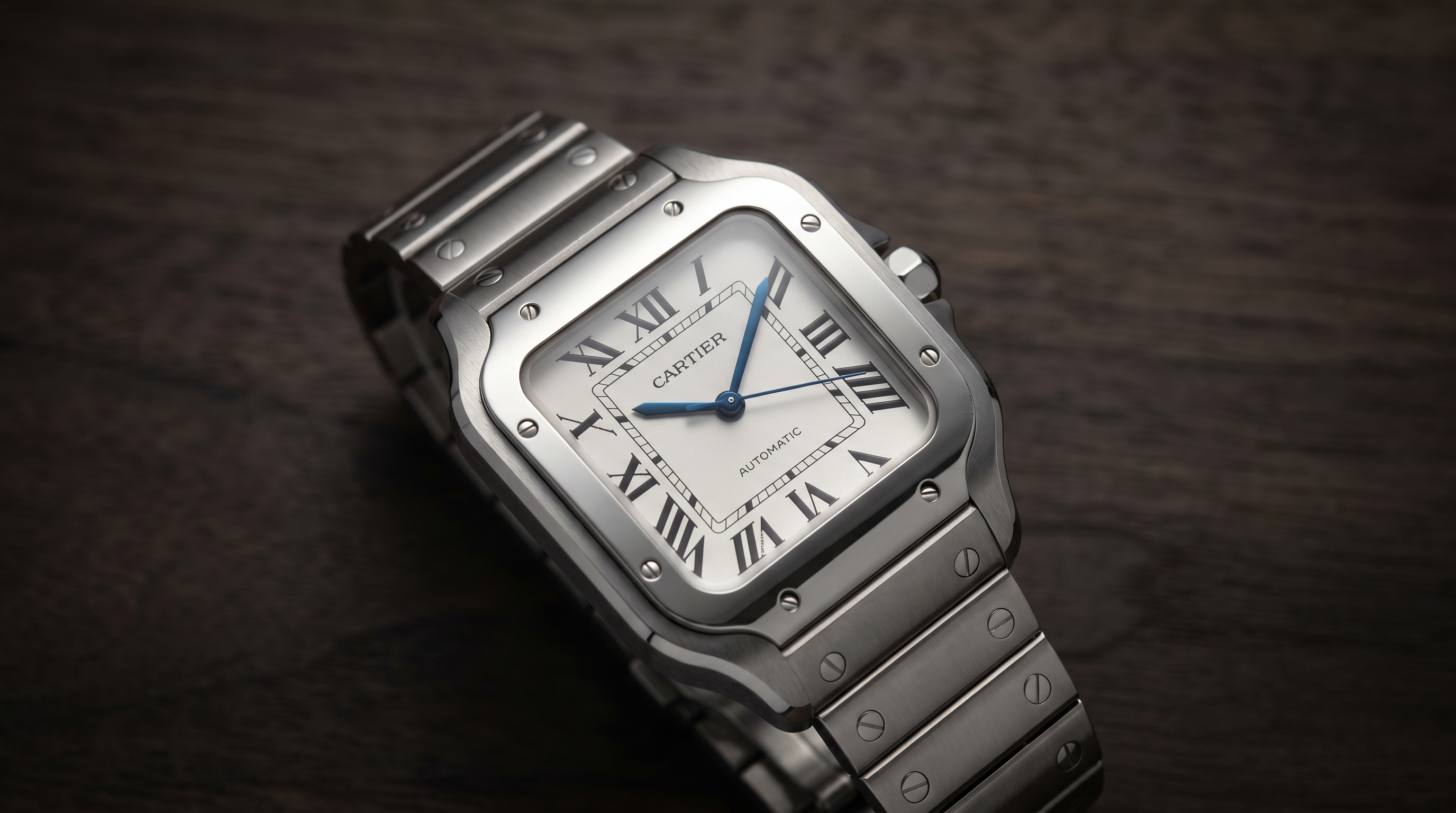
When Richemont released its annual financial results in early 2025, the numbers told a story familiar to anyone tracking luxury goods through the current decade: uneven geography, persistent U.S. strength, and sharp declines in conflict-affected regions. According to Hodinkee, sales in the Americas rose 17% year-over-year for the Swiss conglomerate, while the Middle East—particularly Dubai—saw foot traffic collapse to near zero as the war with Iran disrupted tourism and expatriate spending. Yet within that mixed picture, one name stood out for its ability to weather volatility: Cartier.
Unlike pure-play sports-watch brands or complication-focused independents, Cartier occupies a rare intersection of jewelry heritage, iconic design language, and accessible-to-haute price positioning. The maison's portfolio spans entry-level quartz pieces under $3,500 and six-figure high-complication timepieces, all unified by instantly recognizable case shapes—Tank, Santos, Ballon Bleu—that have remained in continuous production for decades. This breadth, combined with Richemont's scale and distribution, has allowed Cartier to capture demand across demographics and geographies even as tariffs, raw-material inflation, and regional instability pressure margins and sales mix.
For the buyer evaluating a Cartier purchase today, the question is not whether the brand will endure—history and market data answer that affirmatively—but which references offer the best combination of design integrity, mechanical interest, and value retention. This guide examines Cartier's current market position, traces the evolution of its core collections, and identifies the models that merit attention in 2025 and beyond.
From Jeweler to Watchmaker: Cartier's Foundation and the Birth of Modern Wristwatches
Louis-François Cartier took over his master's Parisian workshop in 1847, establishing the house as a purveyor of fine jewelry to European aristocracy. For the first half-century, Cartier's horological output consisted of pocket watches and pendant timepieces, often cased in gold and gem-set to match the maison's jewelry commissions. The pivot to wristwatches came in 1904, when Cartier created the Santos for Brazilian aviator Alberto Santos-Dumont, who needed a timepiece he could read while piloting. The Santos is widely recognized as one of the earliest purpose-built men's wristwatches, predating the popularization of the wristwatch during World War I.
Thirteen years later, in 1917, Cartier introduced the Tank, a rectangular case inspired by the overhead profile of Renault FT-17 tanks used on the Western Front. The Tank's clean lines, integrated lugs, and Roman numeral dial became the template for decades of Cartier watch design. Both the Santos and Tank remain in production today, anchor collections that account for a significant share of Cartier's watch revenue and secondary-market activity.
In 1997, Cartier joined the newly consolidated Richemont Group, which brought together Vendôme luxury brands under a single corporate structure. This move provided capital for movement development and boutique expansion, setting the stage for Cartier's in-house caliber program in the 2010s. The 1847 MC automatic and 1917 MC manual-wind movements now power many core references, reducing reliance on ETA and Jaeger-LeCoultre ébauches and reinforcing Cartier's credentials as a manufacture.
Core References: Santos, Tank, and Ballon Bleu in 2025
Three families dominate Cartier's contemporary catalog and represent the clearest entry points for buyers seeking both wearability and brand equity. Each is available in multiple sizes, materials, and movement configurations; the models below reflect the current "sweet spot" for collectors and daily wearers.
Santos de Cartier Large (WSSA0018)
The modern Santos Large in stainless steel measures 39.8 mm square and houses the Cartier 1847 MC automatic movement, offering approximately 40 hours of power reserve, central seconds, and a date window at six o'clock. The integrated bracelet features Cartier's QuickSwitch system for tool-free strap changes and SmartLink for bracelet micro-adjustment. Retail pricing sits around $7,500 to $8,500 depending on bracelet or strap configuration, positioning the Santos Large as Cartier's most accessible in-house automatic on steel bracelet.
The Santos benefits from strong name recognition—aviator heritage, square case, exposed screws—and a case size that works across wrist dimensions. Secondary-market performance has been stable to modestly positive in 2025, with discontinued dial colors and limited editions trading at or above retail on specialist platforms.
Tank Louis Cartier (Large, Manual-Wind)
The Tank Louis Cartier in its large format (33.7 mm × 25.5 mm) is offered in yellow, white, or rose gold and powered by the 1917 MC hand-wound caliber. Retail prices range from approximately $13,000 to $15,000 in precious metal, reflecting both material cost and the Tank's position as Cartier's most historically significant case shape. The 1917 MC is a modern small-form movement developed in-house, replacing the Piaget-based calibers used in earlier Tank production.
For buyers prioritizing design purity and cultural resonance, the Tank Louis remains the definitive Cartier. Princess Diana's yellow-gold example and Andy Warhol's famously unwound Tank have cemented the model's place in both royal and art-world iconography. The manual-wind ritual and slim profile make the Tank Louis a dress watch in the traditional sense, best suited to formal wear and smaller wrists.
Ballon Bleu de Cartier 36 mm (Automatic, Steel)
Introduced in 2007, the Ballon Bleu brought a softer, more contemporary silhouette to Cartier's lineup. The 36 mm automatic variant in stainless steel retails for approximately $7,000 to $8,000 and uses the 1847 MC movement. The case features a convex sapphire crystal, a blue cabochon crown guard integrated into the case band, and Roman numeral hour markers on a guilloche or sunburst dial.
The Ballon Bleu appeals to buyers seeking a round case with Cartier's design vocabulary—less angular than the Santos, more versatile than the Tank. It has become a popular choice for women and men with smaller wrists, and the 36 mm size offers better proportions than the larger 42 mm or 46 mm variants. Secondary-market liquidity is strong, though premiums are modest outside of discontinued or special-dial references.
Vintage and Discontinued Models: CPCP, Cintrée, and the Collector's Cartier
While the current catalog offers accessible entry points and strong brand recognition, the vintage and discontinued segments reveal Cartier's depth as a design house and the market's evolving appreciation for pre-in-house era production.
Collection Privée Cartier Paris (1998–2008)
The CPCP line represented Cartier's first systematic effort to reintroduce its archival case shapes in limited, high-grade mechanical production. Models included the Tank à Vis, Tortue, Cintrée, and Tonneau, all produced in small batches and powered by outsourced calibers from Piaget, Jaeger-LeCoultre, Frédéric Piguet, and THA. Finishing standards were elevated relative to mainline Cartier, and many pieces featured display casebacks—uncommon for Cartier at the time.
CPCP watches were undervalued for years, dismissed by some collectors as "not real manufacture pieces." That perception has reversed sharply since 2020. Auction results and dealer asking prices have climbed as buyers recognize the quality of the movements, the rarity of the production runs, and the purity of the design execution. A CPCP Tank Cintrée in platinum or a Tortue in yellow gold now commands premiums over original retail and, in some cases, over comparable modern references.
Tank Cintrée (Pre-2000s and CPCP Era)
The Tank Cintrée is Cartier's most elongated Tank variant, with a gently curved case that follows the contour of the wrist. Early examples from the 1920s and 1930s are exceedingly rare; the CPCP reissues from the late 1990s and early 2000s are the most accessible entry point for collectors. These pieces often used Jaeger-LeCoultre or Frédéric Piguet manual-wind calibers and were produced in yellow, white, and rose gold.
The Cintrée is not a daily wearer for most buyers—its proportions are extreme, and legibility is secondary to design—but it represents one of the purest expressions of Cartier's Art Deco language. For the buyer who already owns a Santos or Tank Louis and seeks a more esoteric Cartier, the Cintrée is the logical next step.
Santos "Carée" (1970s–1980s)
The Santos "Carée" (square Santos) from the 1970s and 1980s, including references like the 2960, brought the Santos silhouette to a broader market through two-tone steel and gold executions and quartz or thin automatic movements. These watches are now experiencing a resurgence as entry-level vintage Cartier, appealing to younger collectors and those priced out of modern steel sports watches from other brands.
Condition and originality matter: bracelets are often stretched or incomplete, and dials can show aging or service marks. A clean example with original bracelet and papers trades in the $3,000 to $5,000 range, offering a gateway into Cartier collecting at a fraction of the cost of a new Santos Large.
Market Performance and Secondary-Market Dynamics in 2025
Cartier's secondary-market performance in 2025 has outpaced many competitors, driven by a combination of retail price increases, constrained supply of certain references, and growing collector interest in design-led watchmaking. According to research published by Luxury Watches USA, "Cartier has secured a top-five position in secondary-market gains for 2025," placing the maison alongside Rolex, Patek Philippe, Audemars Piguet, and Richard Mille in terms of value retention and appreciation.
Retail price increases across Cartier's U.S. catalog ranged from 2.4% to 18.8% in 2025, depending on collection and material. The Santos and Tank families saw mid-single-digit increases, while precious-metal and high-complication references experienced steeper adjustments. These increases have compressed the gap between retail and secondary-market pricing, particularly for steel models in high demand.
For core modern references—Santos Large, Tank Solo, Ballon Bleu 36 mm—secondary-market pricing in 2025 tracks near retail for current-production pieces and shows modest premiums for discontinued dials, sizes, or limited editions. Vintage and CPCP pieces exhibit wider variance: high-grade examples with provenance and original accessories command material premiums, while poorly preserved or over-polished pieces languish.
The broader luxury watch market has seen bifurcation between brands with strong secondary liquidity (Rolex, Patek, AP, and now Cartier) and those struggling to maintain retail parity. Cartier's position in the former group reflects both brand strength and the maison's ability to manage supply and distribution through Richemont's boutique network.
Geopolitical Headwinds and Regional Divergence
Richemont's financial results, as reported by Hodinkee, highlight the uneven geography of luxury demand in 2025. U.S. sales rose 17% year-over-year, driven by domestic consumption and a resilient high-net-worth cohort. Johann Rupert, Richemont's chairman, noted that "the US economy, the metrics are still looking better than many other economies," a comment that underscores the relative stability of North American luxury spending even as inflation and interest rates remain elevated.
In contrast, the Middle East—particularly Dubai—experienced sharp declines in foot traffic and sales following the outbreak of war with Iran in late February. Rupert observed that "tourism has dropped to zero" in Dubai, a city that had been a key hub for both regional buyers and international travelers. Abu Dhabi showed signs of recovery, but the broader Middle East region posted a 3% sales decline in Richemont's fourth quarter.
Asia Pacific and China delivered more stable results, with China up 14% in the fourth quarter and Japan jumping 28% year-over-year. These figures reflect both currency dynamics—yen weakness making Japan attractive for foreign buyers—and domestic demand in China as travel restrictions eased and local consumption rebounded.
For Cartier, this regional divergence has several implications:
- U.S. boutiques and authorized dealers remain the most reliable channel for both new and pre-owned inventory, with strong sell-through and limited discounting.
- Middle East inventory may see selective discounting or reallocation to other regions, creating short-term opportunities for buyers with access to those markets.
- Asia Pacific demand continues to support pricing for gold and high-jewelry watches, which skew toward Chinese and Japanese buyers.
- European sales face headwinds from tourism declines and currency weakness, though domestic European buyers remain active in the secondary market.
Buyers should monitor regional pricing and availability, as arbitrage opportunities can emerge when inventory is reallocated or when currency swings create temporary dislocations between retail and secondary-market pricing.
Investment Considerations and Value Retention
Cartier's investment profile differs from that of Rolex or Patek Philippe. The maison does not command the same premiums for steel sports models, nor does it produce the same scarcity-driven hype around new releases. Instead, Cartier offers a combination of design equity, brand recognition, and improving secondary-market liquidity that appeals to buyers seeking long-term value retention rather than short-term flipping opportunities.
Several factors support Cartier's value proposition in 2025 and beyond. First, the maison's in-house movement program has elevated its technical credentials without abandoning the design-first ethos that defines the brand. The 1847 MC and 1917 MC calibers are well-finished, reliable, and serviceable through Cartier's global network, addressing a historical criticism that Cartier watches were "jewelry pieces with off-the-shelf movements."
Second, Cartier's price positioning remains accessible relative to Patek Philippe, Audemars Piguet, and Vacheron Constantin, allowing the brand to capture buyers who aspire to haute horology but are not yet ready to commit $30,000 or more to a single watch. A steel Santos or Tank Solo offers a recognizable design, solid build quality, and entry into the Cartier ecosystem at a fraction of the cost of a Royal Oak or Nautilus.
Third, cultural and celebrity associations continue to drive demand. Princess Diana's Tank Louis, Andy Warhol's Tank, and countless film and fashion appearances have embedded Cartier's case shapes into the broader cultural lexicon. This visibility translates into sustained demand across generations and geographies, insulating Cartier from the cyclical swings that affect less-recognized brands.
For buyers evaluating Cartier as an investment, the following guidelines apply. Steel sports models (Santos, Ballon Bleu) offer the best liquidity and lowest downside risk, trading near retail in the secondary market and appreciating modestly for discontinued or limited-edition variants. Precious-metal dress watches (Tank Louis, Tank Cintrée) appeal to a narrower buyer base but can command premiums when condition, provenance, and originality are strong. Vintage and CPCP pieces require more expertise and patience but offer the highest potential returns for buyers willing to research, authenticate, and hold for the long term.
Navigating the Cartier Catalog: What to Buy in 2025
For the first-time Cartier buyer, the decision tree is straightforward. If you prioritize versatility, wrist presence, and modern engineering, the Santos Large in steel is the default choice. It wears well on a range of wrist sizes, pairs with both casual and business attire, and benefits from strong secondary-market support. If you lean toward dress watches and appreciate manual-wind movements, the Tank Louis in yellow or rose gold offers the purest expression of Cartier's design language and the deepest historical roots.
For the buyer who already owns a Santos or Tank and seeks to deepen their Cartier collection, the next tier includes the Ballon Bleu (for a round case option), the Tank Américaine (for a more contemporary Tank silhouette), or a vintage CPCP piece (for rarity and elevated finishing). Each of these references brings something distinct to the collection without duplicating the core Santos or Tank aesthetic.
For the advanced collector, the focus shifts to discontinued references, limited editions, and high-complication pieces. The CPCP Tank Cintrée, the Tortue in platinum, and the Crash (when available) represent the apex of Cartier's design ambition and command the strongest premiums in the secondary market. These are not daily wearers for most buyers, but they offer the highest degree of exclusivity and the greatest potential for long-term appreciation.
Regardless of entry point, buyers should prioritize originality, condition, and provenance. Cartier's service network is extensive, but over-polishing, dial refinishing, and incorrect parts can erode value and authenticity. Full sets—watch, box, papers, and service records—trade at meaningful premiums over watch-only examples, particularly for vintage and discontinued references.
0 comments